
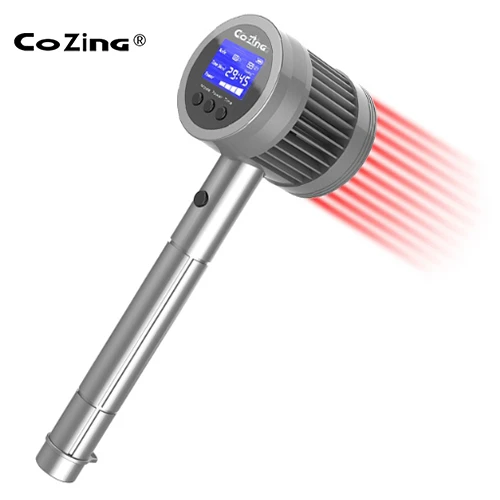
What are the indications of COZING-T05 IV laser therapy?
- Sports injuries, osteoarthritis, sprains and strains, fractures, foot injuries, ankle joint injuries. Knee injury, hip injury, lower back injury, mid back injury, neck injury, shoulder injury, elbow injury, wrist/hand injury, dizziness (BPPV), peripheral neuropathy.
- Post concussion syndrome,knee, hip, and ankle osteoarthritis, rheumatoid arthritis, shoulder impingement syndrome, hip or shoulder bursitis, lumbar disc degeneration, disc herniation, sciatica, neuropathic pain, tendonitis, plantar fasciitis, and lymphedema pain.
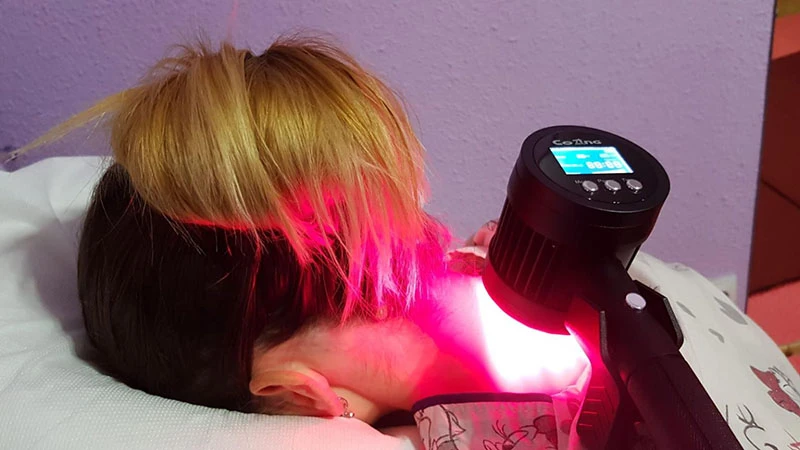
What’s the technical parameter of the COZING-T05 IV laser therapy ?
|
Model: |
COZING-T05 |
|
Laser medium: |
GaAIAs Semiconductor |
|
Laser wavelength: |
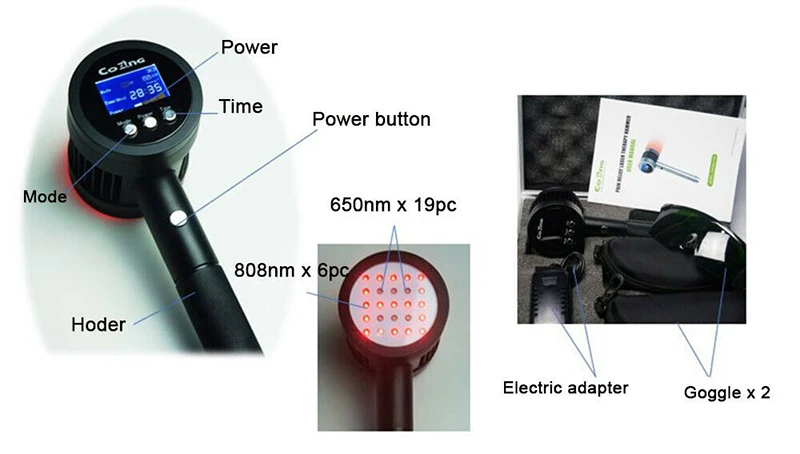
650nm±20nm, 808nm±20nm |
|
Single laser meduumn terninate output voltage: |
650nm— 5mw+20% 808nm—-200mw+20% |
|
Terminal laser output mode: |
Continuous and pulse |
|
Terminate output laser power intensity: |
4 grade for adjusting |
|
Battery voltage: |
3.7-4.2V |
|
Iithiumn battery capacity: |
5200mAh |
|
Fixed time range: |
10 minutes to 60minutes, and six grade for adjustment |
What are the advantages of COZING-T05 IV laser therapy?
1. Perfect combination of 650nm and 808nm lasers with a maximum output of 1200mW.
2. Treatment mode and power can be adjusted as needed even during use.
3. Battery-powered, reusable.
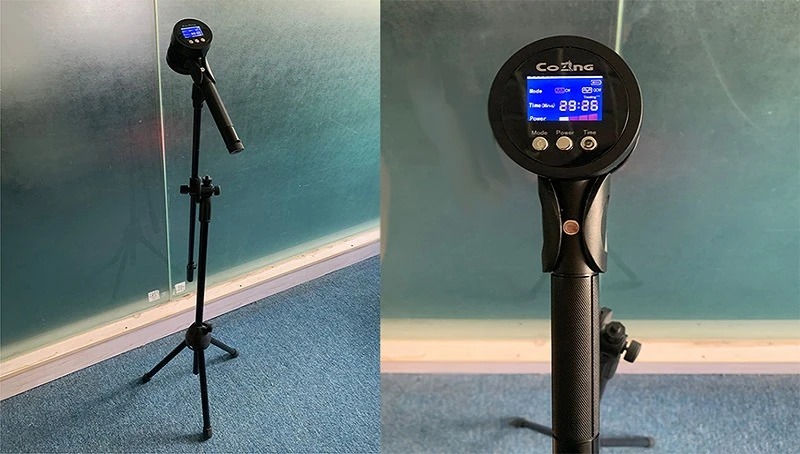
4. Hands-free device.
5. Suitable for home, clinical, and hospital use with a good return on investment.
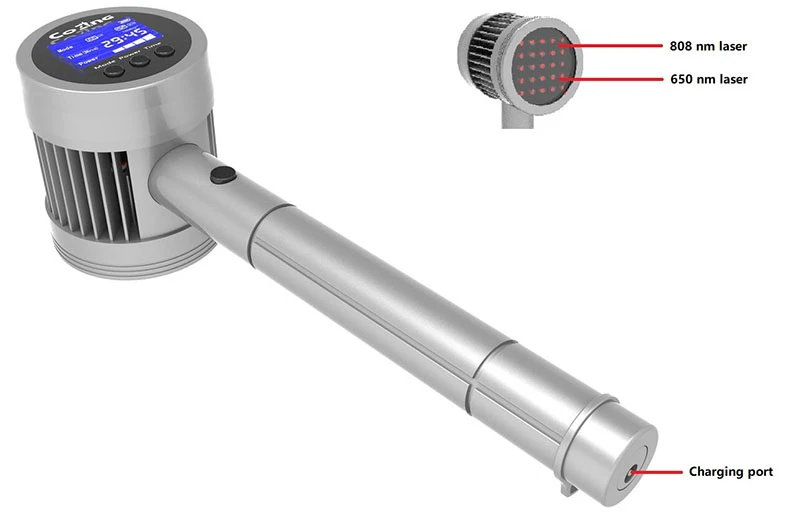
COZING-T05 IV laser therapy Display:
How does COZING-T05 IV laser therapy work?
The COZING-T05 IV laser therapy device uses low-level laser therapy (LLLT) to promote healing and provide pain relief.
Laser Emission:The device emits low-level lasers at specific wavelengths (usually around 808nm and 650nm) that penetrate the skin and tissues.The laser light is absorbed by the cells in the targeted area. This light energy is then converted into cellular energy, primarily through the process involving mitochondria.This absorption of light energy stimulates various cellular processes:
- Increased ATP Production: The mitochondria produce more adenosine triphosphate (ATP), the energy currency of cells, leading to enhanced cell function and repair.
- Enhanced Blood Flow: LLLT promotes vasodilation, which improves blood flow to the affected area, delivering more oxygen and nutrients and removing waste products.
- LLLT helps reduce inflammation by decreasing the levels of pro-inflammatory cytokines and increasing the production of anti-inflammatory mediators. This helps in reducing swelling and pain.
Clinical study:
Objective
Osteoarthritis (OA) and rheumatoid arthritis (RA) impact a significant portion of the population. Low-level laser therapy (LLLT) emerged as a noninvasive alternative treatment for RA and OA about a decade ago, though its effectiveness remains debated. We evaluated the efficacy of LLLT in managing RA and OA.
Methods
We included only randomized controlled trials that examined LLLT in patients diagnosed with RA or OA. Thirteen studies met the criteria, involving 212 patients assigned to laser treatment, 174 patients to placebo laser, and 68 patients who received active laser on one hand and placebo on the other. The treatment period varied from 4 to 10 weeks. Follow-up data was provided by only 2 trials, extending up to 3 months.
Results
For RA patients, LLLT resulted in a 70% reduction in pain compared to placebo, decreased morning stiffness by 27.5 minutes (95% CI -52.0 to -2.9), and improved fingertip-to-palm flexibility by 1.3 cm (95% CI -1.7 to -0.8). No significant differences were found between the groups regarding functional assessment, range of motion, or local swelling. Subgroup analyses showed no significant differences based on LLLT dose, wavelength, treatment site, or duration.
Conclusion
LLLT may be considered for short-term relief of pain and morning stiffness in RA, particularly given its minimal side effects.
FAQ