
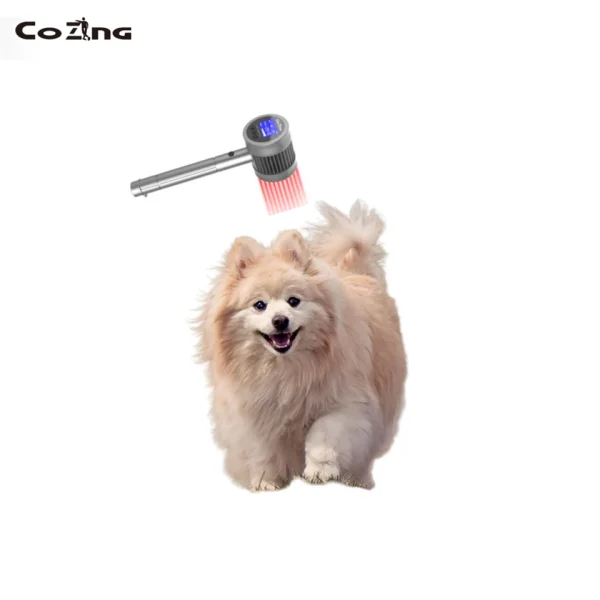
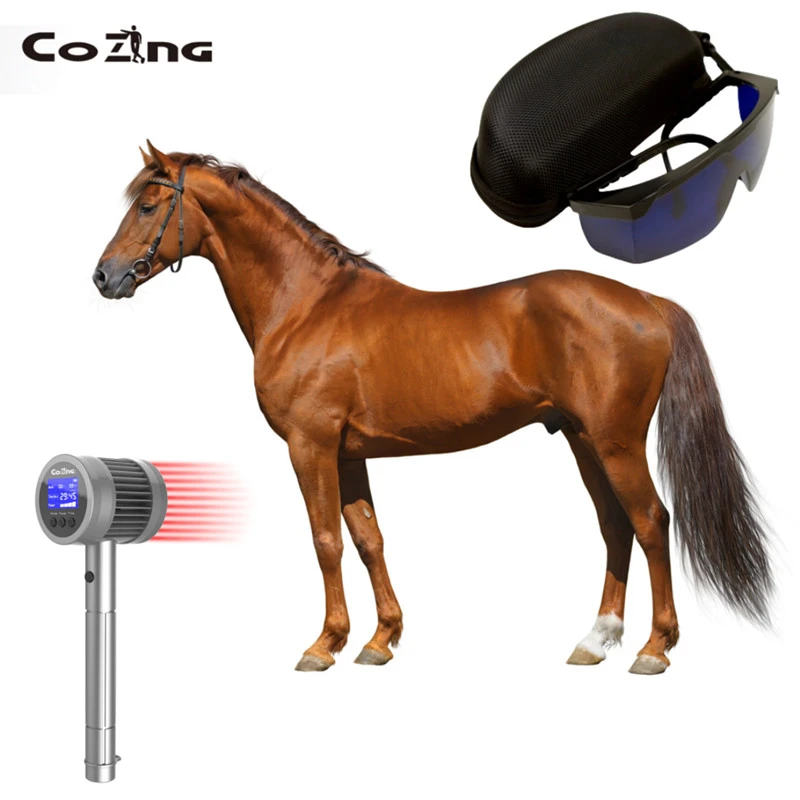
Infections
Sprains & Strains
Post-surgical
Osteoarthritis
Inflammation
Inflammatory Bowel Disease
Lick Granuloma
Wounds
Fractures
Degenerative Joint Disease
Dental Procedures
What’s the technical parameter of the COZING-T05V pet laser therapy at home ?
|
Model |
COZING-T05V |
|
Laser Type |
Class 4 Semiconductor Diodes |
|
Wavelengths |
808nm (6 diodes) + 650nm (19 diodes) |
|
Power |
250mW (808nm), 5mW (650nm) per diode |
|
Total Output |
1295mW (±20%) |
|
Battery |
5200mAh lithium |
|
Modes |
Continuous/Pulse |
|
Applicability |
For Pets and Humans |
|
Frequency |
1-9999Hz as the options |
What is the advantages of the COZING-T05V pet laser therapy at home?
1. Dual wavelength synergy 808nm (6 diodes, 250mW each): deep penetration into joints/bones
650nm (19 diodes, 5mW each): Surface healing for wounds/skin
2.1295mW high intensity output.
3. No side effects compared to traditional methods
4. Can relieve pets from osteoarthritis pain, hip dysplasia, etc.
5. Can be customized according to wavelength, power, packaging
Canine Laser Therapy Protocol (COZING-T05V)
|
Condition |
Wavelength |
Power |
Mode |
Time |
Frequency |
Treatment Course |
|
Infections |
650nm (19 diodes) |
Low (5mW) |
Continuous |
5-7 mins/site |
Low |
Daily × 5-7 days |
|
Sprains & Strains |
808nm (6 diodes) |
High (250mW) |
Pulsed |
8-10 mins |
Medium-High |
Daily (acute), EOD (chronic) |
|
Osteoarthritis |
808nm + 650nm combo |
High + Low |
Alternating |
12-15 mins |
Medium |
3x/week × 8 weeks |
|
Inflammation |
808nm (6 diodes) |
Medium-High |
Pulsed |
6-8 mins |
Medium |
Daily × 3-5 days |
|
Inflammatory Bowel |
650nm (19 diodes) |
Low (5mW) |
Continuous |
5 mins/abdomen |
Low |
3x/week × 4 weeks |
|
Lick Granuloma |
650nm (19 diodes) |
Medium |
Pulsed |
5-7 mins |
Medium |
Daily × 10-14 days |
|
Degenerative Joint |
808nm (6 diodes) |
High (250mW) |
Pulsed |
10-12 mins |
High |
3x/week × 10 weeks |
Clinical studies
Background.
Osteoarthritis is common in older dogs and is associated with chronic pain and decreased mobility. The primary objective of this study was to investigate whether low-intensity laser therapy (LLLT) improves physical mobility in dogs with osteoarthritis.
Methods.
Twenty-three dogs with osteoarthritis wore accelerometers 48 hours (baseline) prior to their first treatment with low-intensity laser therapy (irradiation with a COZING-T05V laser), and their daily activities were recorded.Each dog received six consecutive laser treatments per week. Canine Brief Pain Inventory and Liverpool Osteoarthritis in Dogs scores were recorded prior to LLLT treatment (as baseline) and weekly for 6 weeks thereafter for clinical evaluation and as a tool for adjusting the analgesic regimen for each dog. The Liverpool Osteoarthritis in Dogs
Results
The number of daily activities increased during week 2 (161,674; SD, 103,666) and remained above baseline levels (93,481; SD, 107,878) until week 6 (179,309; SD, 126,044; p < 0.001). Compared with baseline levels (1109; SD, 1061), the number of daily steps increased from week 1 (4472; SD, 3427) and remained above baseline levels until the end of week 6 (8416; SD, 3166; p < 0.001). Mean energy expenditure during the study period was 179 [range, 2-536] kcal/day; there was no statistically significant difference in this variable between weeks of treatment. Systemic analgesic therapy was reduced in 50% of the dogs during the study period.
Conclusion.
Laser therapy may facilitate the treatment of osteoarthritis in dogs by increasing their activity levels, thereby improving their quality of life.
Hot Tags: pet laser therapy at home, China pet laser therapy at home manufacturers, suppliers, factory, cold laser therapy for dogs at home, equine cold laser therapy, cat laser therapy, laser treatment for canine arthritis, laser treatment for arthritis in dogs, canine cold laser therapy