
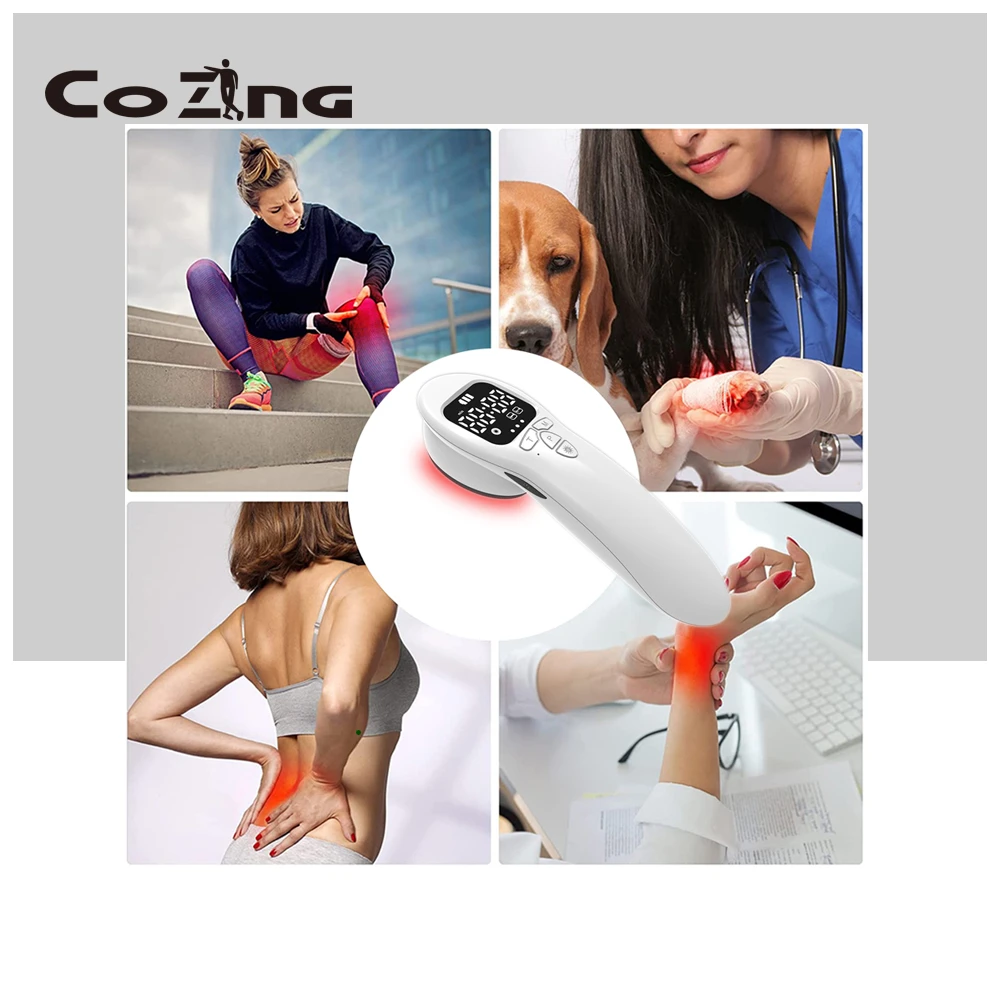
What’s the indications of handheld laser for pain?
Bursitis
Fibromyalgia
Knee Pain
Muscle Pain / Spasms
Shoulder / Rotator Cuff
Tendonitis
TMJ Pain / Dysfunction
Whiplash
Back Pain / Neck Pain
Carpal Tunnel Syndrome
Heel Spurs / Plantar Fasciitis
Migraine Headaches
Nerve Pain / Radiculopathy Sciatica
Sprain / Strain
Tennis Elbow
Trigeminal Neuralgia
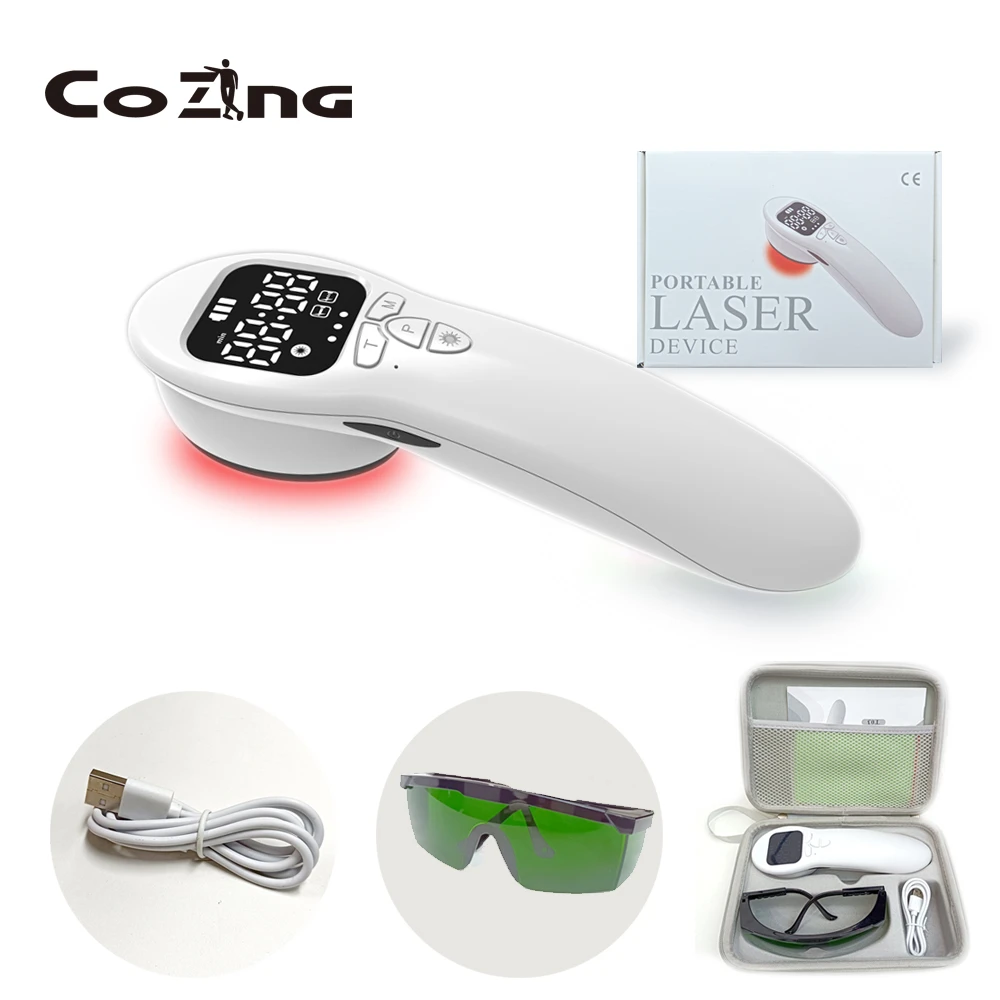
What’s the technical parameter of handheld laser for pain?
|
Model: |
COZING-T03 |
|
Laser Type: |
GaAIAs Diode Laser |
|
Wavelength: |
650nm*14+808nm*3 |
|
Terminal laser output: |
3 laser beams with 808nm, 150mw each laser beam, invisible output 14 laser beams with 650nm, 5mW each laser beam, visible output |
|
Material: |
ABS |
|
Working Mode: |
Continuous Wave & Pulsed Wave, Adjustable |
|
Battery Capacity: |
5600mAh |
|
Power Source: |
Battery, Power Adapter, Rechargeable Battery |
|
Input Voltage: |
100-240V, 50/60Hz |
What is the principle of handheld laser for pain?
1.The core technology of our laser therapy devices is based on diode lasers. Thanks to their relatively simple monolithic semiconductor architecture, they are able to convert electrical energy directly into laser light. Diode lasers also offer unique power and wavelength scalability, the combination of which supports a very wide range of medical applications.
2.Different semiconductor compositions enable wavelength selection, which is accomplished by setting the output wavelength to different wavelength ranges – these wavelengths typically provide the desired power level. In this way, most wavelengths of medical interest can be generated, and the wide selection of output wavelengths allows the laser system to be customized to best meet the needs of each specific application; for example, maximizing blood coagulation, tightening collagen, maximizing tissue ablation, maximizing soft tissue penetration depth or limiting it to surface treatments, destroying target cells, and so on.
3.For each of these applications, there is an optimal wavelength or wavelengths that provide the best selectivity; that is, the laser produces maximum results while minimizing any adverse side effects.
Clinical Studies:
When choosing cold laser therapy, you should be knowledgeable about the research related to the therapy. There is some research to support the use of low-intensity laser therapy for back pain, neck pain, and tendonitis.
1.A 2015 meta-analysis (examining data from a large number of independent studies) found that cold laser therapy had a positive effect on reducing pain in patients with low back pain. However, these studies did not show an increase in functional movement.
2.Another meta-analysis found that the use of cold laser therapy reduced joint pain.4 Another meta-analysis found that the use of cold laser therapy reduced joint pain, but again, did not find that the therapy had any benefit in improving the overall functioning of the patients.
3.If you have tendonitis (inflammation of the tendons that connect muscles to bones) or tenosynovitis (inflammation of the tendons and their surrounding sheaths), your healthcare practitioner may choose to use laser therapy for you.
4.A 2021 meta-analysis of the use of cold laser therapy for the treatment of tendinopathy concluded that “there is very low to moderately high-quality evidence that photobiomodulation (cold laser) can be used as a stand-alone and/or adjunctive therapy for the treatment of tendinopathy.”
Hot Tags: handheld laser for pain, China handheld laser for pain manufacturers, suppliers, factory, laser light therapy for arthritis, laser used by chiropractor, laser treatment for slip disc, hand held cold laser, light therapy for arthritic knees, cold laser therapy chiropractic